Physical Address
304 North Cardinal St.
Dorchester Center, MA 02124
Physical Address
304 North Cardinal St.
Dorchester Center, MA 02124


Do you want to have good credit in the United States, but you’re being asked for a credit history you don’t have yet? It may seem like a difficult cycle to break, but there are ways to get started even from scratch.
At us.tutarjetaideal.vip, we help you understand which cards can help you start building your credit history, what you should review before applying for one, and how to use them responsibly. Because getting your first card is only the beginning: what you do with it during the following months can make the difference.
Keep reading and discover how to take your first steps without making things complicated or committing the most common mistakes.
If you’re starting from scratch, you need to generate information that can appear on your credit report. One way to do this is by opening a card whose issuer reports your account activity to the major credit bureaus.
A secured credit card can be an alternative for getting started. You normally have to make a deposit that works as collateral. You then use the card to make purchases, receive your statement, and make the corresponding payments.
You don’t need to make large purchases. You can start by using the card for one or two expenses that are already within your budget. The important thing is to create a good habit from the beginning: spend with control and pay on time.
There isn’t just one type of card for getting started. The right option will depend on your situation, your income, and the requirements established by each issuer.
These are some alternatives you may find:
Before applying for one, check one essential point: whether the issuer reports account activity to the credit bureaus. If your main goal is to build credit history, this detail matters more than having points, miles, or cash back.
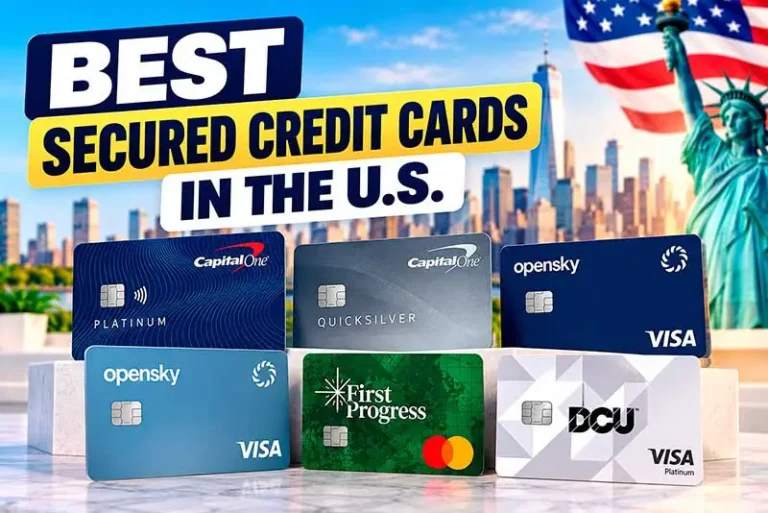
If you’re starting to build credit in the U.S., choosing the right card can make a difference. These six options let you quickly compare costs, APRs, and key requirements before deciding which one best fits your situation.
| Credit Card | Key Requirement | Purchase APR | Annual Fee |
|---|---|---|---|
| Discover it® Student Cash Back | No credit score required to apply* | 0% for 6 months; then 16.49%–25.49% variable APR | $0 |
| Self Visa® Secured Credit Card | No hard credit inquiry; $100 minimum security deposit | 27.49% | $0 for the first year; $25 thereafter |
| Discover it® Student Chrome | No credit score required to apply* | 0% for 6 months; then 16.49%–25.49% variable APR | $0 |
| Capital One Platinum Secured Credit Card | $49, $99 or $200 refundable minimum security deposit | 28.99% variable APR | $0 |
| Capital One Quicksilver Secured Cash Rewards Credit Card | $200 refundable minimum security deposit | 28.99% variable APR | $0 |
| Blue Business Cash® Card from American Express | Business credit card; approval subject to issuer review | 0% for 12 months; then 16.74%–28.49% variable APR | $0 |
*No credit score is required to apply for the Discover student cards,
but approval is not guaranteed. APRs, fees and card terms may change.
Check the issuer’s current terms before applying.
The easiest difference to understand is the deposit.
A secured card normally requires you to put down an amount of money as collateral. For example, you could make a $300 deposit and receive a credit line related to that amount, depending on the issuer’s terms. The deposit works as security; it does not replace the monthly payments you must make for your purchases.
A traditional card, on the other hand, generally does not require that deposit. The bank reviews your application and determines whether to approve you and what credit limit to give you.
| Feature | Secured Card | Traditional Card |
|---|---|---|
| Security deposit | Normally yes | Normally no |
| Can help you get started | Yes | Depends on the product |
| Access with limited credit history | May be more accessible | Depends on the issuer |
| Reporting to credit bureaus | You should verify | You should verify |
| Benefits and rewards | Depends on the card | Depends on the card |
Yes, it can if the issuer reports your activity to the credit bureaus and you use the account correctly.
It is not the deposit that builds your credit history. What matters is the behavior you generate after opening the card: using credit responsibly and making your payments.
For that reason, a secured card should not simply be viewed as a card for people who cannot get another one. It can be an entry tool into the U.S. credit system.
Each bank establishes its own conditions, and approval is never guaranteed. Depending on the product, you may be asked for information to verify your identity, address, income, and financial situation.
You should also check which identification document the issuer accepts. Some institutions may accept an ITIN (Individual Taxpayer Identification Number) for certain products when the applicant does not have a Social Security Number (SSN).
My recommendation is to review the requirements before submitting an application. It doesn’t make much sense to apply for cards at random hoping one will approve you; it is better to first look for products that fit your profile.
When you’re starting out, I wouldn’t choose a card just because it offers cash back, points, or miles. First, I would check how much it costs to keep and whether it can actually fulfill the goal of helping you build credit history.
Before deciding, review:
A simple card with low costs may make much more sense when starting out than one packed with benefits you don’t need yet.
Suppose you receive a card with a $500 limit. Having $500 available does not mean you should spend the $500, nor do you need to make additional purchases just to try to improve your credit.
The most practical approach is to use it for expenses that are already within your budget. It could be gas, groceries, your phone bill, or a subscription. Then, keep your balance low in relation to your limit and, if you can, pay the balance in full each month. You do not need to spend up to a certain percentage to build credit.
Stick to three simple habits:
The key is not how much you spend, but showing over time that you can manage a line of credit responsibly.
One of the easiest mistakes to make is confusing your credit limit with additional money. If you have a $1,000 limit, that does not mean you have earned an extra $1,000. Every dollar you use will have to be paid back.
I would also avoid:
You do not need to go into debt to prove that you know how to use a card. The goal is exactly the opposite: learn how to manage credit without losing control of your finances.
Credit history is not built after your first purchase. You need to accumulate information for several months so there is enough activity to evaluate your financial behavior.
As a reference, to generate a FICO score, you generally need at least one account that has been open for six months or more and at least one account that has been reported to the credit bureaus within the past six months. This does not mean you will automatically have an excellent score after six months.
Think of your credit as a financial reputation: it is built little by little. The longer you maintain good habits, the more information lenders will have to evaluate how you manage your obligations.
If I were starting my credit history from scratch, I wouldn’t look for the card with the most rewards first. I would look for an option that is easy to understand, affordable to keep, and suitable for someone with little credit history.
Then, I would use it only for purchases that are already within my budget. I would keep the balance low compared with the available limit and, whenever possible, pay the balance in full each month.
Your first card doesn’t have to stay with you for the rest of your life either. Its first mission can be much simpler: help you show that you know how to manage credit responsibly. Once you have a stronger credit history, you can compare other cards and decide whether their rewards, benefits, or terms are really worth it.
Yes, as long as you understand from the beginning why you want it.
You don’t need to spend a lot, carry debt, or fill your wallet with cards. You need an account that fits your situation and good habits that you can repeat every month.
At us.tutarjetaideal.vip, we want to help you make precisely that decision: understand credit cards before applying, compare their terms, and find alternatives that make sense for where you are financially. Building credit is not a race; starting correctly can be more important than trying to do it quickly.